sbi reloaded: a toolkit for simulation-based inference workflows
- 1 minScientists and engineers often rely on complex and stochastic computational simulators to describe the dynamics of their system - whether it is the electrochemical interactions of neurons, the merging of black holes, or anything in between. These simulators allow us to give inputs (parameters) describing the system, to make predictions (observations) about them. Practitioners often want to ask the opposite question. If we observe an experimental measurement - which parameters of the simulator could explain it, and how likely are the parameters to have produced this observation? Simulation-based inference (SBI) describes a family of methods which uses algorithms from probabilistic machine learning to answer such questions for any simulator. However, probabilistic machine learning research may not be accessible to domain scientists and engineers, and building ML workflows to apply SBI methods can be a significant time investment for practitioners. This is where the sbi toolkit comes in - we implement and maintain the newest SBI methods, with a user-friendly interface to enable practitioners to solve challenging inference problems for their computational simulators, without also having to become ML experts.
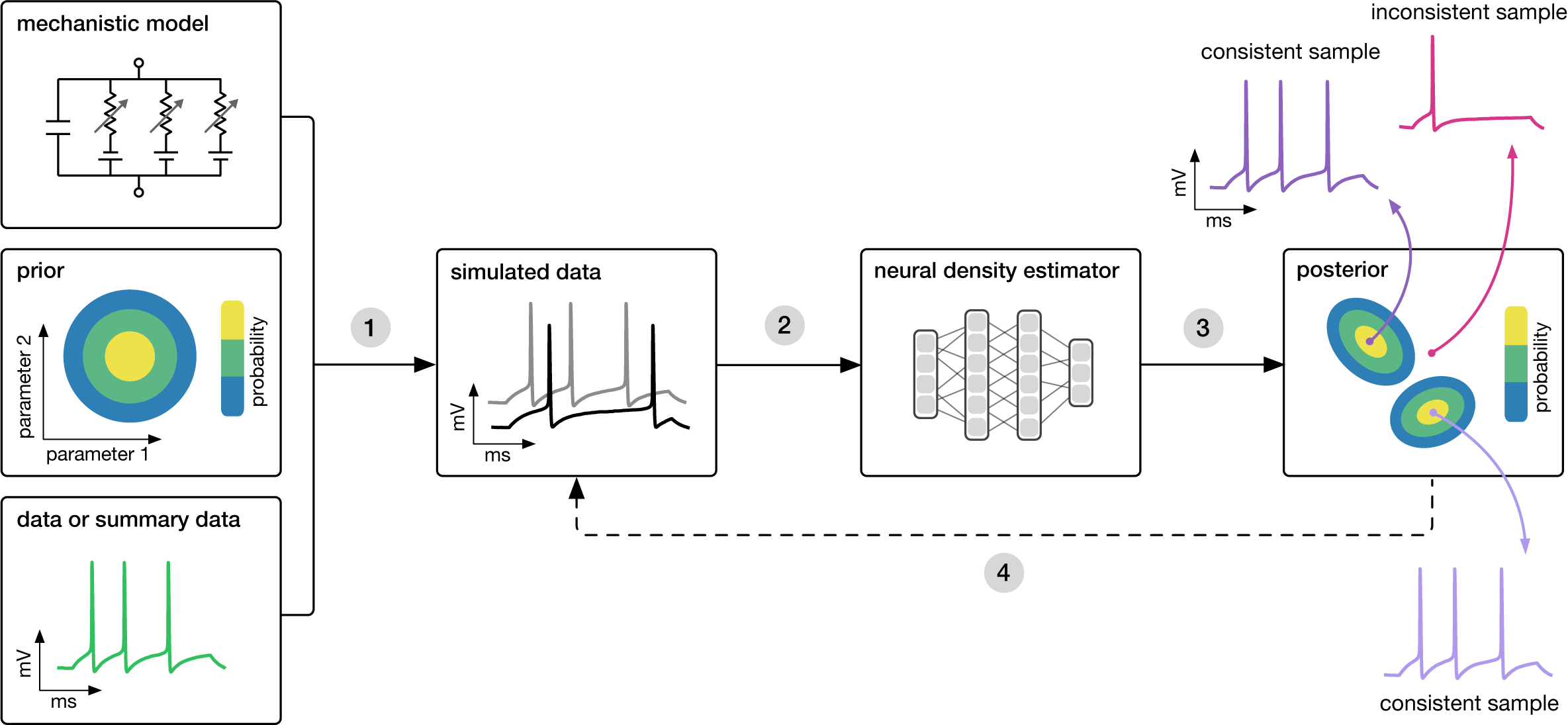
The sbi toolbox has been actively maintained and upgraded since its creation in 2021. It is used in many scientific works (including my own). I have had the privilege to work in the large and diverse team led by Jan Teusen and Michael Deistler in maintaining, but also extending the toolkit with new features. These new feature include score-based and flow-based models for likelihood and posterior estimation, new diagonstic tools of inference calibration, and extensive tutorials. We continue to work on improving this toolkit and helping scientists and engineers in a variety of disciplines use it to empower their research. We recently published an updated software paper, as well as a practical guide which help practioners navigate the growing field of simulation-based inference.